Unreachable Owners, Unacceptable Risks: How Offshore Property Ownership Is Paralyzing UK Safety Enforcement

When a UK enforcement officer identifies a serious safety deficiency in a commercial or residential property, the immediate priority is to establish who bears legal responsibility for addressing it. In a straightforward ownership structure, this is a manageable task. The registered proprietor is identified at HM Land Registry, a notice is issued, and the enforcement process proceeds.
 Photo: HM Land Registry, via images.squarespace-cdn.com
Increasingly, however, that first step leads not to a named individual or a domestic company but to a labyrinth of offshore entities, nominee arrangements, and jurisdictional boundaries that enforcement bodies are ill-equipped to navigate. The result is a growing class of dangerous properties where accountability is, in practical terms, absent — and where the risk falls upon those least responsible for creating it.
The Scale of Offshore Ownership in UK Property
The extent of overseas and offshore ownership within the UK property market is substantial and, until relatively recently, was largely opaque. Analysis of Land Registry data has consistently identified significant volumes of commercial and residential property held through companies registered in British Overseas Territories, Crown Dependencies, and jurisdictions with limited disclosure requirements.
The Register of Overseas Entities, introduced under the Economic Crime (Transparency and Enforcement) Act 2022, represented a significant legislative step towards greater transparency, requiring overseas entities owning UK property to disclose their beneficial owners. However, compliance with the register has been uneven, enforcement of non-compliance has been limited, and the register itself does not resolve the practical difficulties that arise when enforcement bodies attempt to compel action from a duty holder located in a foreign jurisdiction.
For safety regulators, the problem is not merely one of information. Even where the ultimate beneficial owner of a property can be identified, pursuing enforcement action against an individual or entity in, for example, the British Virgin Islands, Hong Kong, or the United Arab Emirates presents challenges that the current legislative framework was not designed to overcome.
What Safety Law Requires — and Who It Reaches
The legal obligations attaching to property ownership and occupation under UK safety law are numerous and well-established. The Regulatory Reform (Fire Safety) Order 2005 imposes duties on the "responsible person" for a premises — typically the owner, employer, or occupier — to carry out fire risk assessments and maintain appropriate fire safety measures. The Housing Act 2004, as it applies to houses in multiple occupation, places licensing and safety obligations on landlords. The Defective Premises Act 1972 imposes a duty of care on landlords who retain an obligation to repair.
These obligations do not evaporate because the owner is domiciled abroad. The duty follows the property and the role. Where an overseas owner has appointed a UK-based managing agent to administer the property, that agent may acquire significant legal exposure — often without fully appreciating the extent of it.
The critical question, and one that is rarely examined with sufficient rigour at the point of appointment, is precisely which obligations the managing agent has assumed. A management agreement that grants broad operational authority over a property may, in law, confer the status of "responsible person" or equivalent duty holder upon the agent, regardless of whether the agreement itself uses that language.
Managing Agents in the Firing Line
For UK-based managing agents operating on behalf of overseas landlords, the compliance landscape is treacherous. Where an agent collects rent, arranges maintenance, and manages tenant relationships, they may find themselves characterised by enforcement bodies as the effective controller of the premises — with all the liability that entails.
This is not a theoretical concern. Environmental health officers and fire safety inspectors have pursued enforcement action against managing agents where the registered owner could not be effectively reached. The practical logic is straightforward: the agent is present, identifiable, and capable of taking action. The enforcement notice goes to them.
Managing agents who have not obtained adequate indemnification from their overseas clients, who have not secured appropriate professional indemnity insurance, or who have not clearly delineated the scope of their responsibilities in the management agreement are particularly exposed. The absence of the landlord from the jurisdiction does not create a legal vacuum — it transfers the risk to whoever is standing closest.
Nominee Structures and the Accountability Deficit
Beyond simple overseas ownership, a subset of properties is held through nominee arrangements in which the registered legal owner is a local agent or professional acting on behalf of a disclosed or undisclosed principal. These structures, while not inherently improper, can create acute difficulties for enforcement bodies attempting to identify who bears ultimate responsibility for a dangerous condition.
Where a property is owned by a nominee company whose sole function is to hold title, and whose directors are professional nominees with no operational involvement in the property's management, the chain of accountability may be effectively severed for practical enforcement purposes. The nominee has no authority to spend money on remediation. The beneficial owner cannot be compelled through domestic enforcement mechanisms. Tenants and occupiers meanwhile inhabit the building.
This accountability deficit is particularly acute in the context of fire safety. Following the Grenfell Tower disaster and the subsequent Hackitt Review, the building safety regulatory framework was substantially reformed through the Building Safety Act 2022. That Act introduced the concept of the Accountable Person — the entity responsible for managing building safety risks in higher-risk residential buildings. Where the Accountable Person is an overseas entity that cannot be effectively engaged, the system faces a structural failure.
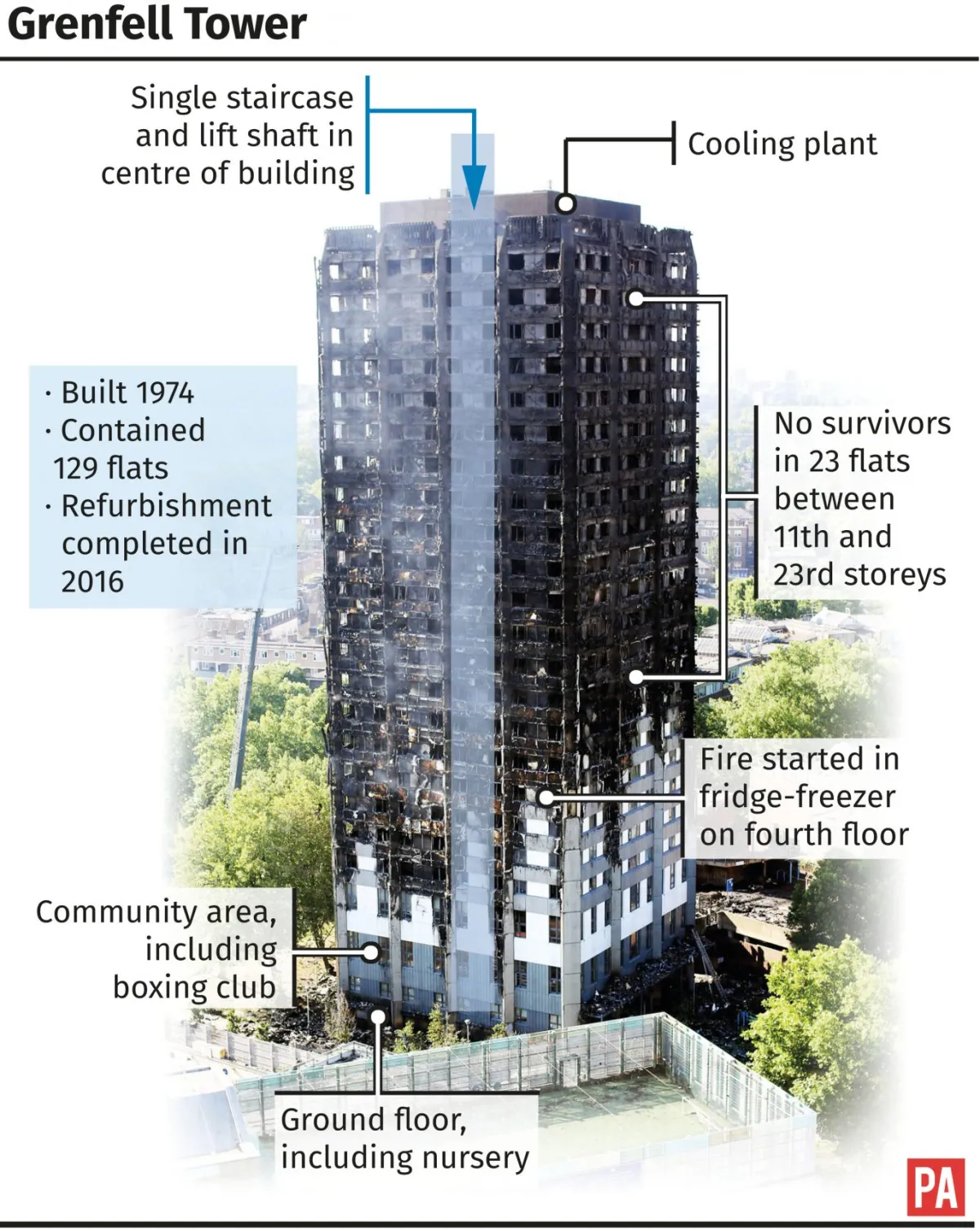 Photo: Grenfell Tower, via content.assets.pressassociation.io
The Burden on Tenants and Occupiers
Those who bear the greatest physical risk from this enforcement gap are, invariably, the people who live and work in the properties concerned. Commercial tenants in unsafe premises may face the unwelcome choice between accepting dangerous conditions and breaching their leases by vacating. Residential occupiers in poorly maintained buildings may lack the resources or knowledge to pursue civil remedies against an absent landlord.
Local authorities possess powers under various legislative instruments — including the Housing Act 2004 and the Environmental Protection Act 1990 — to carry out emergency remedial works and charge the costs to the property. However, recovering those costs from an overseas entity is a further enforcement challenge, and the financial risk of non-recovery may deter authorities from exercising these powers as readily as the situation warrants.
Is the Legislative Framework Adequate?
The honest answer, for now, is that it is not. The Register of Overseas Entities represents progress, but transparency alone does not resolve the enforcement gap. What is required is a mechanism by which UK regulatory obligations can be effectively discharged regardless of where ultimate ownership resides — whether through mandatory appointment of UK-based responsible persons, strengthened powers to appoint managers in the event of owner non-compliance, or enhanced international enforcement cooperation.
Pending such reform, the responsibility for bridging the gap falls upon those intermediaries — managing agents, property managers, and professional advisers — who operate between absent owners and occupied buildings. For those parties, understanding the full extent of their potential liability is not merely prudent. It is essential.
At National Safety Inspections, we support managing agents and property professionals across the UK in assessing and documenting their compliance obligations, ensuring that the gap between an absent landlord and a safe building is not filled by regulatory exposure they did not anticipate and cannot afford. Where ownership is complex, safety obligations must be simple — and clearly owned.