Lost in Induction: The Safety Compliance Gap Emerging Across UK Skilled Worker Visa Programmes

The United Kingdom's reliance on international recruitment has intensified considerably since the post-Brexit restructuring of the immigration system. The Skilled Worker visa route has become a primary mechanism through which employers in healthcare, construction, engineering, hospitality, and logistics have addressed persistent workforce shortages. Home Office data confirms that hundreds of thousands of Skilled Worker visas are granted annually, with the numbers continuing to grow across a broad range of occupational categories.
 Photo: United Kingdom, via ontheworldmap.com
For the employers sponsoring these workers, the immigration compliance obligations are well understood — sponsor licence management, certificate of sponsorship administration, right-to-work verification. What is far less well understood is the parallel set of health and safety obligations that attach specifically to this cohort of workers from the moment they begin employment, and the ways in which standard induction processes routinely fail to meet them.
The Legal Framework That Applies Without Exception
The Health and Safety at Work Act 1974 is unambiguous in its scope. It applies to all workers in Great Britain, regardless of nationality, immigration status, or length of employment. Section 2 of the Act places a general duty on employers to ensure, so far as is reasonably practicable, the health, safety, and welfare at work of all their employees. This duty explicitly includes the provision of such information, instruction, training, and supervision as is necessary to ensure the health and safety of employees.
 Photo: Great Britain, via cdn.thecollector.com
The Management of Health and Safety at Work Regulations 1999 expand on this, requiring employers to take account of workers' capabilities and to provide comprehensible and relevant information about risks and protective measures. The word 'comprehensible' is doing significant legal work in that formulation. Information that is provided in a language or at a level of technical complexity that a worker cannot reasonably understand is not, in law, comprehensible — and an employer who relies on such information to satisfy their statutory duty is on weak legal ground.
For overseas workers arriving from countries with different regulatory traditions, different workplace cultures, and potentially different primary languages, the standard induction pack — a series of policy documents, a brief walkthrough, and a signature on a form — may satisfy no one's definition of comprehensible information delivery.
Where Standard Inductions Fall Short
The failures in overseas worker safety induction tend to cluster around three distinct areas, each of which creates its own compliance exposure.
Language and communication barriers represent the most immediately apparent risk. Many Skilled Worker visa holders arrive with professional-level English sufficient for their technical role but with limited familiarity with the specific vocabulary of UK health and safety regulation. Terms such as 'risk assessment', 'method statement', 'permit to work', 'COSHH', and 'near-miss reporting' carry precise regulatory meanings in the UK context that may not translate intuitively from other regulatory traditions. An induction that uses these terms without explanation — or that relies on written documentation alone — cannot be said to have communicated effectively.
Regulatory framework unfamiliarity creates a deeper structural problem. Workers arriving from countries with different occupational health and safety regimes may hold assumptions about employer and worker responsibilities that are incorrect in the UK context. In some regulatory cultures, safety compliance is understood as an employer's exclusive responsibility, with workers having minimal reporting obligations. In the UK, Section 7 of the Health and Safety at Work Act places explicit duties on employees — to take reasonable care of their own and others' health and safety, and to cooperate with employers on safety matters. Workers who are not informed of these duties cannot be expected to fulfil them.
Cultural attitudes toward risk reporting represent perhaps the most operationally significant gap. Research across occupational safety disciplines consistently identifies under-reporting of near-misses, incidents, and hazards as a major barrier to workplace safety improvement. For workers from cultural backgrounds where reporting problems to management is associated with professional vulnerability or social stigma, a standard 'open door' assurance from a line manager is unlikely to be sufficient. Effective induction for this cohort requires explicit discussion of the UK reporting culture, the legal protections available to workers who raise safety concerns, and the practical mechanisms through which concerns can be raised confidentially.
The Growing HSE Scrutiny
The Health and Safety Executive has, in recent years, intensified its focus on workforce demographics as a factor in workplace injury and incident rates. Sector-specific inspection campaigns in construction, food processing, and healthcare — all significant employers of Skilled Worker visa holders — have included explicit examination of induction and training adequacy for non-native English speaking workers.
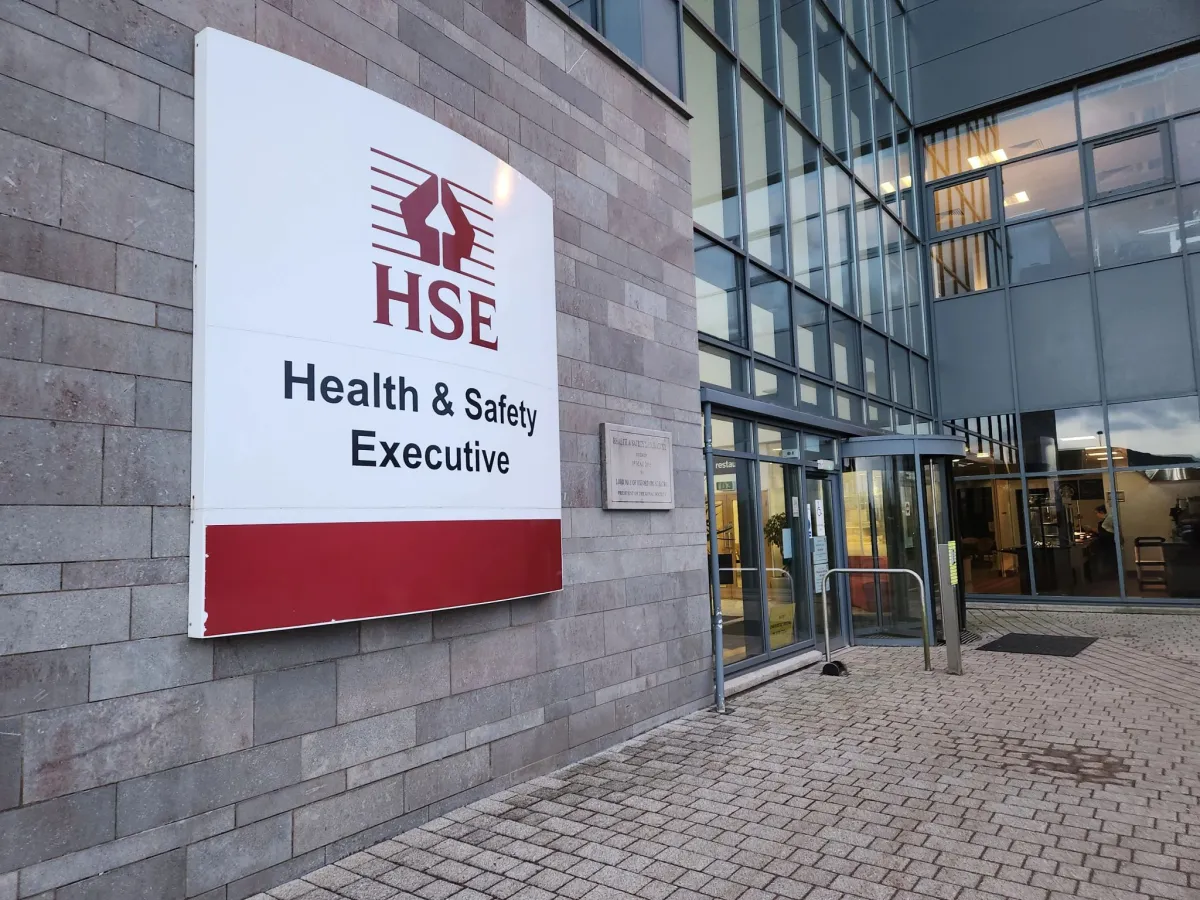 Photo: Health and Safety Executive, via threerivershealthandsafety.co.uk
HSE enforcement notices and improvement notices published in recent years include cases where employers have been found to have failed in their duty to provide comprehensible safety information to workers with limited English language proficiency. In the most serious cases, these failures have been cited as contributory factors in prosecutions following serious injuries. The emerging regulatory direction is clear: the HSE does not accept that providing information in English to a worker whose primary language is not English constitutes adequate discharge of the employer's duty, where the employer knew or should have known of the language limitation.
For licensed sponsors, the stakes are compounded. A serious safety enforcement action against a licensed sponsor can attract Home Office attention to the sponsor licence itself, creating a risk that extends well beyond the immediate HSE investigation.
What Tailored Induction Looks Like in Practice
Employers who take their obligations seriously in this area are moving beyond the standard induction model towards a structured, differentiated approach that accounts for the specific characteristics of their overseas recruits.
This begins at the pre-arrival stage. Sending key safety documentation — including emergency procedures, reporting mechanisms, and an overview of UK health and safety law — in the worker's primary language before they arrive allows familiarisation without the cognitive pressure of the first day in a new country.
On arrival, induction should be conducted with interpretation support where needed, whether through a bilingual colleague, a professional interpreter, or validated translation of written materials. Verbal confirmation of understanding — through questions and practical demonstrations rather than signatures alone — provides a more reliable evidence base for compliance.
The induction programme should explicitly address UK-specific concepts: the role of the HSE, the meaning and purpose of risk assessments, the worker's own legal duties under the 1974 Act, and the specific mechanisms for raising safety concerns within the organisation. Where workers are employed in roles involving hazardous substances, working at height, or operation of plant and equipment, role-specific safety training should be provided in a format that accounts for language and prior experience.
Finally, a structured review period — perhaps at one month and three months post-commencement — allows employers to identify and address gaps in safety understanding before they translate into incidents.
A Compliance Obligation, Not a Discretionary Courtesy
It is important to be clear about the nature of these obligations. Tailored induction for overseas workers is not a gesture of cultural sensitivity or a voluntary enhancement to standard practice. It is the minimum required to satisfy the legal duty to provide comprehensible safety information to all employees. Employers who treat it as optional are not merely falling short of best practice — they are operating in breach of statutory duties that carry criminal penalties.
As the UK's dependence on international recruitment deepens, and as HSE inspection activity in affected sectors intensifies, the employers who have invested in genuinely inclusive safety induction will find themselves well positioned. Those who have relied on the assumption that a standard process is adequate for all workers, regardless of background, are accumulating a compliance liability that is becoming harder to ignore.