Green Retrofit, Red Alert: How Sustainability Upgrades Are Triggering Unforeseen Safety Violations
The Decarbonisation Dilemma
Across the United Kingdom, a quiet revolution is transforming commercial rooftops and plant rooms. Driven by government net-zero targets and escalating energy costs, businesses are retrofitting buildings with solar panels, battery storage systems, and heat pump technology at unprecedented rates. The Department for Business, Energy and Industrial Strategy estimates that over 45,000 commercial properties underwent significant energy retrofits in 2023 alone.
However, this rush towards sustainability is creating an unexpected compliance crisis. Many retrofitting projects are inadvertently invalidating existing fire risk assessments, electrical installation certificates, and structural load calculations — leaving businesses exposed to serious regulatory breaches despite their environmental good intentions.
When Solar Panels Become Fire Hazards
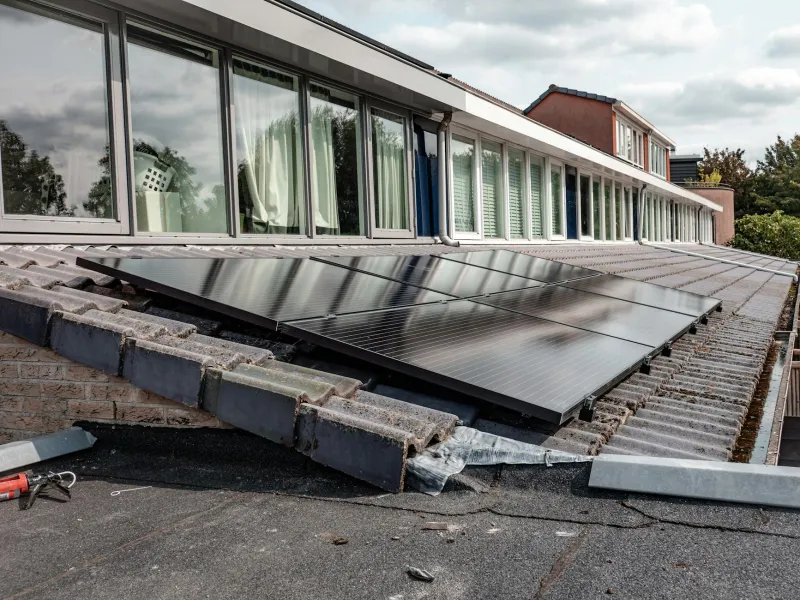
Solar photovoltaic installations represent the most popular commercial retrofit option, with costs falling dramatically and payback periods shortening to under seven years for many applications. Yet the fire safety implications of rooftop solar arrays remain poorly understood by many installers and building operators.
The primary concern lies in fire loading — the additional combustible material that solar panels introduce to building structures. Modern PV modules contain polymer back-sheets and junction boxes that can ignite and propagate fire across roof surfaces. When combined with DC electrical systems operating at voltages up to 1,500V, the fire risk profile of a building changes fundamentally.
Existing fire risk assessments rarely account for these new hazards. A typical assessment conducted before solar installation focuses on traditional fire sources: electrical distribution boards, heating systems, and occupant activities. The addition of extensive rooftop PV arrays introduces new ignition sources and fire spread pathways that original assessments never considered.
A recent incident at a warehouse in Northampton demonstrated these risks dramatically. Solar panels installed eighteen months earlier ignited during routine maintenance work, with fire spreading rapidly across polymer mounting systems. The subsequent investigation revealed that the original fire risk assessment had never been updated to reflect the changed risk profile, leaving the building without adequate protection measures for the new installation.
Battery Storage: The Hidden Electrical Overload Crisis
Lithium-ion battery energy storage systems (BESS) have become increasingly popular as businesses seek to maximise solar investment returns through peak shaving and grid arbitrage. However, these systems introduce complex electrical and thermal hazards that existing building safety documentation rarely addresses.
The fundamental issue lies in electrical load management. Most commercial buildings were designed with electrical infrastructure sized for traditional loads: lighting, HVAC systems, and standard equipment. Battery charging systems can draw substantial power during off-peak periods, potentially overloading circuits and distribution equipment never intended for such demands.
Moreover, lithium-ion batteries present unique fire risks through thermal runaway — a process where individual battery cells overheat and trigger cascading failures throughout the system. Unlike traditional electrical fires, battery fires produce toxic gases and can reignite hours after apparent extinguishment.
A logistics company in Birmingham discovered these risks when their newly installed 100kWh battery system triggered multiple electrical protection devices during initial commissioning. Investigation revealed that the existing electrical installation condition report (EICR) had not been updated to reflect the additional loads, leaving circuits operating beyond their designed capacity.
Heat Pump Installations: Structural Stress and Noise Compliance
Commercial heat pump retrofits present different but equally serious compliance challenges. These systems typically require substantial outdoor units weighing several tonnes, often installed on rooftops or external structures never designed for such loads.
Structural load calculations become critical when retrofitting heat pumps, yet many installations proceed without proper structural assessment. The consequences can be severe: a retail unit in Cardiff suffered significant roof damage when heat pump mounting brackets failed during high winds, creating not only repair costs but serious safety hazards for pedestrians below.
Additionally, heat pump noise output often triggers environmental health compliance issues. The Control of Pollution Act 1974 and subsequent regulations establish strict limits on commercial noise emissions, particularly during night-time operation. Heat pumps operating continuously can easily breach these limits, especially in mixed-use areas where residential properties adjoin commercial premises.
The Insurance Exclusion Reality
Insurance companies have begun responding to retrofit-related risks by introducing specific exclusion clauses that many businesses discover only after suffering losses. Standard commercial property policies increasingly exclude claims arising from renewable energy installations unless specific conditions are met.
These conditions typically require updated fire risk assessments, structural load confirmations, and electrical certification that reflects post-installation conditions. Businesses that retrofit without updating their safety documentation often find themselves without insurance coverage precisely when they need it most.
A manufacturing company in Leeds learned this lesson expensively when a fire originating from their solar installation caused £380,000 in damage. Their insurer rejected the claim on grounds that the original fire risk assessment had not been updated to reflect the PV installation, breaching policy conditions that required current safety documentation.
Regulatory Enforcement Catches Up
Building control authorities and HSE enforcement teams are beginning to focus attention on retrofit compliance gaps. Recent prosecutions demonstrate that businesses cannot assume retrofitting activities fall outside regulatory oversight.
The key issue lies in the definition of 'material alterations' under building regulations. Many retrofit projects that businesses consider minor modifications actually constitute material alterations requiring formal building control approval and updated safety assessments.
Furthermore, the Electricity at Work Regulations 1989 require that electrical installations remain safe throughout their operational life. Adding significant new loads through battery charging or heat pump operation can render existing installations non-compliant, creating criminal liability for duty holders who fail to reassess their systems.
The Path to Compliant Retrofitting
Successful retrofit projects require a compliance-first approach that integrates safety assessment into initial planning stages. This means treating existing safety documentation as living documents that must evolve alongside building modifications.
Fire risk assessments should be updated before any retrofit work begins, with assessors specifically briefed on planned installations. The assessment should consider not only the new equipment but changed evacuation routes, firefighting access, and emergency service capabilities in the event of incidents involving renewable energy systems.
Electrical installation condition reports must be updated to reflect new loads and distribution requirements. This often reveals the need for electrical infrastructure upgrades that should be factored into project costs from the outset.
Structural assessments become essential for any equipment adding significant loads to building structures. Professional engineers should confirm that existing structures can safely support new installations under all foreseeable conditions, including extreme weather events.
Building Safety Into Sustainability
The transition to net-zero commercial operations represents both an environmental necessity and a significant business opportunity. However, the compliance challenges associated with building retrofits require careful management to avoid transforming sustainability investments into safety liabilities.
Businesses that approach retrofitting with proper compliance planning find that updated safety assessments often identify additional efficiency opportunities and risk reduction measures. Rather than viewing safety compliance as an obstacle to sustainability, successful operators treat it as an integral component of responsible environmental management.
The message is clear: achieving net-zero goals cannot come at the cost of safety compliance. In an era where both environmental performance and safety standards face increasing scrutiny, businesses must demonstrate that their sustainability credentials are built on foundations of comprehensive regulatory compliance.
The companies that master this balance will find themselves well-positioned for a future where environmental performance and safety excellence are equally essential for long-term success.